
HSA vs FSA: What's the Difference, and Which Should You Use?
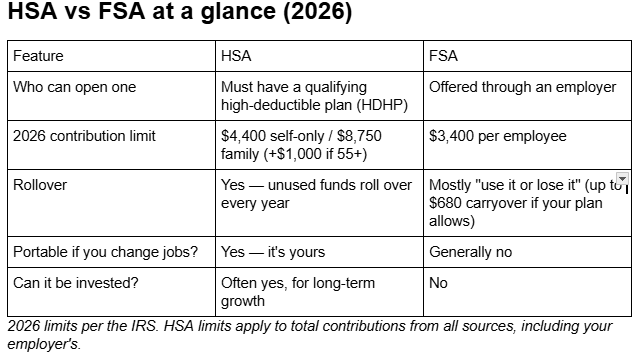
Short answer: an HSA and an FSA both let you set aside pre-tax money for medical costs, but they follow very different rules. The biggest differences: an HSA requires a high-deductible health plan, the money is yours forever and rolls over year to year, and it goes with you if you change jobs. An FSA is offered through an employer, mostly "use it or lose it," and doesn't travel with you. Here's how to tell them apart and pick the right one.
The core difference
Think of it this way: an HSA is a savings account you own; an FSA is a spending account your employer runs. That single distinction drives almost every other rule — who can open one, whether the money rolls over, and whether you keep it when you leave a job (IRS Publication 969: https://www.irs.gov/publications/p969).
Why people love the HSA
The HSA has a rare "triple tax advantage": contributions go in pre-tax, the money can grow tax-free, and withdrawals for qualified medical expenses are tax-free too. Because it rolls over and is yours to keep, many people use it as a long-term health nest egg — even into retirement. The catch is you must be enrolled in a qualifying high-deductible plan to contribute.
When an FSA makes sense
An FSA is a great fit if your employer offers one and you have predictable expenses for the year — copays, prescriptions, dental, vision. Estimate carefully, because most of the money doesn't roll over. It also doesn't require a high-deductible plan, so it works alongside more traditional coverage.
Frequently asked questions
What's the difference between an HSA and an FSA? An HSA is an account you own, requires a high-deductible health plan, rolls over every year, and is portable between jobs. An FSA is employer-run, mostly use-it-or-lose-it, and generally doesn't travel with you.
What are the 2026 HSA contribution limits? $4,400 for self-only coverage and $8,750 for family coverage, plus an extra $1,000 catch-up if you're 55 or older. Limits include employer contributions.
What is the 2026 FSA limit? $3,400 per employee for a health FSA, with up to $680 in carryover if your employer's plan allows it.
Can I have both an HSA and an FSA? Usually not a general-purpose FSA at the same time as an HSA, because it can disqualify HSA contributions. A "limited-purpose" FSA (dental/vision) can sometimes pair with an HSA. Confirm with your employer or a professional.
Which account fits your plan?
The right choice often starts with the right health plan. Talk to a licensed agent (https://optimizedinsuranceplans.com/talk-to-zac) at 801-785-1676, or explore your options (https://optimizedinsuranceplans.com) — with zero pressure.
This article is for general educational purposes only and is not insurance, tax, or medical advice. Account rules and IRS limits can change — verify current details and consult a tax professional. Optimized Insurance Plans is a licensed insurance agency; talk with a licensed agent about your specific needs.