
HMO vs PPO vs EPO vs POS: Which Plan Type Is Right for You?
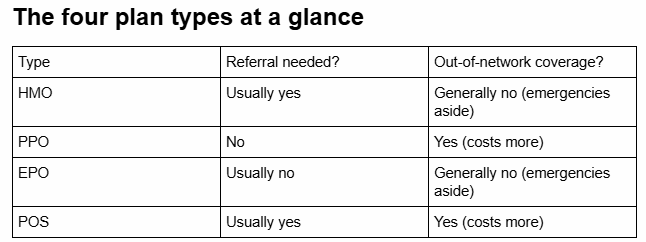
Short answer: HMO, PPO, EPO, and POS are all "plan types," and the difference comes down to two questions — do you need a referral to see a specialist, and does the plan cover out-of-network care? PPOs are the most flexible (and usually priciest); HMOs are the most structured (and often cheapest); EPOs and POS plans sit in between. Here's how to tell them apart and match one to how you actually use care.
The two questions that separate them
Every one of these plan types is really answering two things: (1) Do you need a primary care physician (PCP) and referrals to see specialists? and (2) Will the plan pay anything if you go out of network? Get clear on those two and the alphabet soup sorts itself out (HealthCare.gov: https://www.healthcare.gov/choose-a-plan/plan-types/).
Which one fits you?
HMO if you want lower costs and don't mind coordinating care through a PCP, and your doctors are in-network.
PPO if you value flexibility — seeing specialists without referrals and having some out-of-network coverage — and will pay more for it.
EPO if you want PPO-style freedom from referrals but can stay in-network to save money.
POS if you like the HMO structure but want the option to go out of network occasionally.
The mistake to avoid
Don't pick a plan type by name alone — always check that your specific doctors and preferred hospital are in that plan's network, and that your medications are covered. Two plans labeled "PPO" can have very different networks. Confirming the network is the single most important step, and it's exactly where an agent saves you from a costly surprise.
Frequently asked questions
What is the difference between an HMO and a PPO? An HMO usually requires a primary care doctor and referrals and generally doesn't cover out-of-network care, but costs less. A PPO lets you see specialists without referrals and covers some out-of-network care, but usually costs more.
What is an EPO plan? A hybrid: usually no referrals (like a PPO), but no out-of-network coverage except emergencies (like an HMO). Flexibility at a lower price if your providers are in-network.
What does POS mean? Point of Service — blends HMO and PPO: you typically use a PCP and referrals, but can go out of network at a higher cost.
Which plan type is cheapest? HMOs and EPOs are often lower-cost because they keep care in-network. But "cheapest" depends on your doctors, medications, and usage — compare total costs, not just premiums.
Not sure which type fits your doctors?
We'll check your providers against each plan's network. Talk to a licensed agent (https://optimizedinsuranceplans.com/talk-to-zac) at 801-785-1676, or explore your options (https://optimizedinsuranceplans.com) — with zero pressure.
This article is for general educational purposes only and is not insurance, tax, or medical advice. Plan features, networks, and rules vary by plan and state and can change. Optimized Insurance Plans is a licensed insurance agency; talk with a licensed agent about your specific needs.